
This is the user manual for the best German Anki deck, ÜBERDeck, specifically the 1,500 Core Vocab Edition. If you don’t have the deck already, you can pick it up here.
How do I install the ÜBERDeck?
First you need to purchase and download the ÜBERDECK from here.
Once you’ve downloaded the ÜBERDeck file, you will need to download and install Anki onto Windows or macOS: https://apps.ankiweb.net/ (once you’ve set it up on your computer you can install the app on your phone and then log in with your Anki account to sync your decks.)
Next, open Anki and go to File > Import and then select the UBERDECK1500.apkg file you downloaded.
If you already have the deck imported into Anki and are downloading an updated version, you can use the update option to update your existing deck.
If you want to get into the details of how Anki works and how to customise it, I recommend reading https://docs.ankiweb.net/background.html or asking ChatGPT to help.
How do I sync the deck with my phone?
First, make sure to follow the instructions above to set up the deck on your computer. Next, go to Anki > Preferences > Syncing and log in with your AnkiWeb account (you will need to create one if you don’t already have one.)
Once you’ve created your account, sync your decks and upload them to your AnkiWeb account. This is a free service provided by Anki and allows you to keep your decks synchronised across your devices.
Next, install the Anki app onto your phone and log in with your Anki account. You can now sync your decks and the ÜBERDeck will appear on your phone.
Don’t forget to tap sync before and after each study session. This ensures your progress is maintained across devices and there are no conflicts.
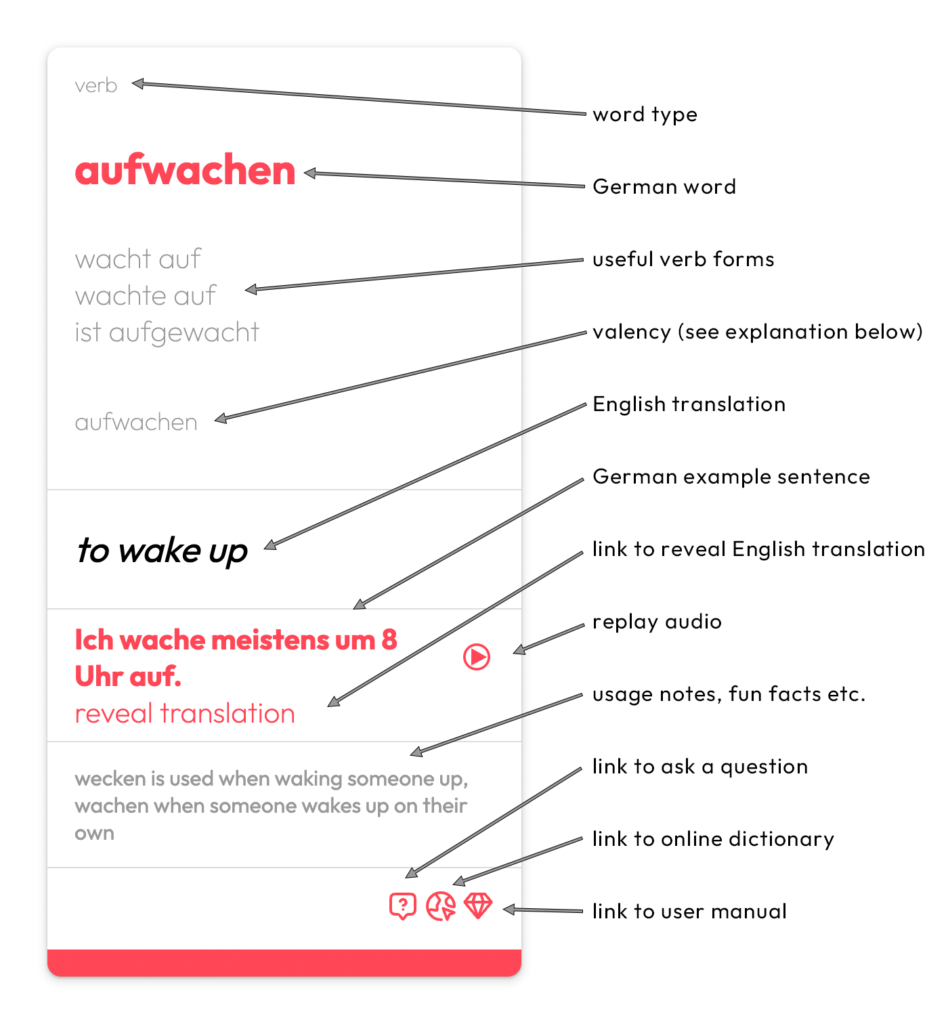
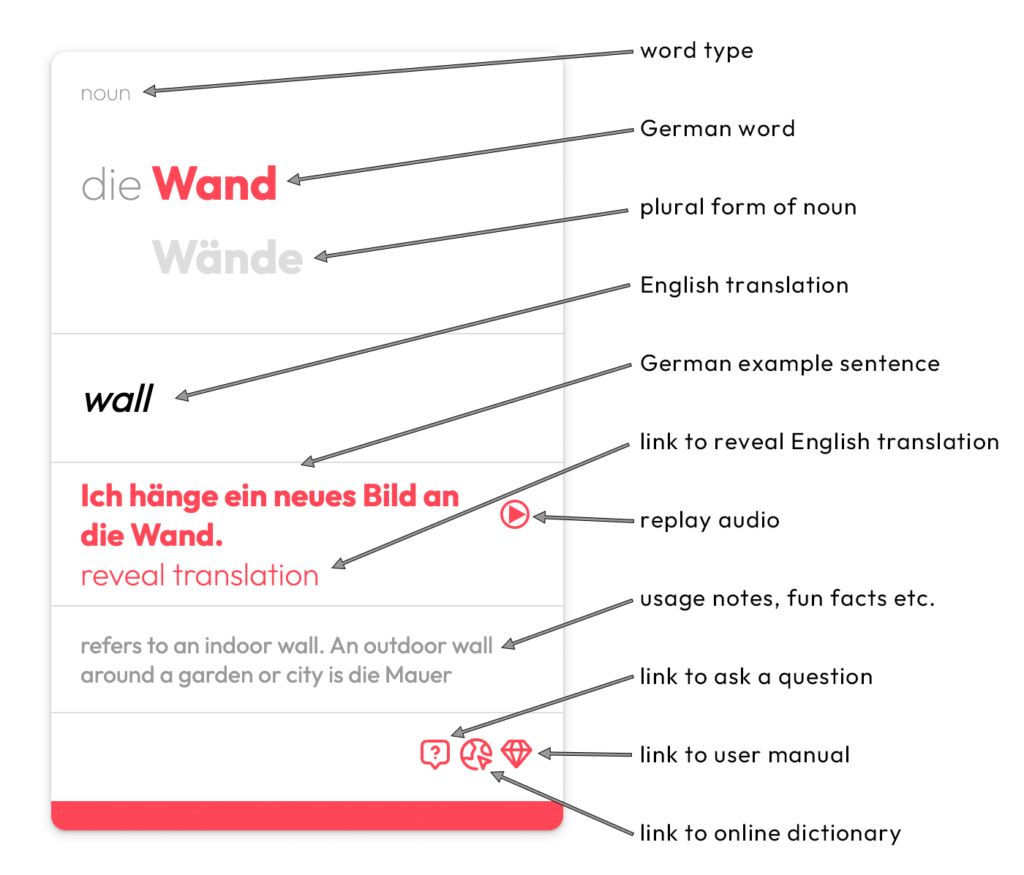
How are the cards structured?
Example of a verb card
Example of a noun card
How do I change the colour of the cards?
To change the colour of the cards, go to Notes > Manage Note Types, select UBERDECK1500, click Cards on the right-hand side and then select the Styling radio button. Near the top of the text box you will see –accent: #ff595e; This can be changed to any html colour you like. Click Save in the bottom right to save your changes.
Here are some suggested colours you might want to try, or you can choose your own (just google html colour codes).
ff595e
ffca3a
8ac926
1982c4
6a4c93
Some plurals have an exclamation mark. What does that mean?
I’ve marked some of the plural forms with an exclamation mark to indicate that the plural refers to multiple types of those things. You don’t need to worry about learning this, but I’ve included it for completeness.
Some plurals have two exclamation marks. What does that mean?
I’ve marked some of the plural forms with two exclamation marks to indicate that the plural form, although it technically exists, is so archaic or rarely used that even native speakers don’t know it. You don’t need to worry about learning them, but I’ve included them for completeness.
Some plurals have a dash. What does that mean?
If the plural form is marked with a dash it means that there is no plural form for that word.
Why are some nouns only listed in plural?
This is because they are either used almost exclusively in the plural form, or the singular form doesn’t exist.
Why do many of the words have multiple translations?
I’ve listed the most common translations of each word to give you a general feeling of what it means and to make you aware of different contextual meanings. The translations are intended to aid understanding rather than as something to learn directly. It is much more effective to focus on example sentences and contexts.
Since I’ve only included one example sentence for each word to keep it simple, it is sometimes the case that one of the translated meanings is not reflected in the example sentence context. It is however sometimes the case that one of these additional meanings will occur in another of the example sentences, and if it doesn’t, you will encounter it soon enough in your German input. You can also click on the search icon in the bottom right of each card to look the word up online for additional contexts and examples.
Sometimes the translation of the word doesn’t appear in the English translation of the example sentence. Why is that?
The word translation gives the closest English equivalents of the German word, but this doesn’t always mean that the most natural English translation of the word in context will include it.
In other words, the words are translated literally, but the sentences are translated idiomatically.
Lets take auf etwas verzichten as an example. This translates as “to do without something”. The German example is “er verzichtet auf den Nachtisch”, which literally means “he does without dessert”, but this sounds weird in English, so I went for “he skips dessert” instead.
Why are some of the sentences translated in the simple present (I eat), while others use the present continuous (I am eating) or even future (I will eat)?
German does not distinguish between the simple present and the present continuous like English does. “Ich esse das Brot” can be translated as “I eat the bread” and “I am eating the bread” and even “I will eat the bread”. This is actually one less thing to worry about as it makes choosing a tense in German very easy.
I translated each sentence according to my gut feeling about the most likely context in English. The purpose of the translation is to get you to understand the German directly, not for you to reverse translate and learn how to say those English sentences in German.
Why are the sentences so short?
I’ve intentionally chosen short sentences that demonstrate the meaning of each word in as basic a context as possible. This makes the reviews fast, easy and stress-free. Users often report that keeping cards quick and simple is the key to staying consistent and having fun while learning. This matches my own experience as well. I always dreaded cards with long sentenced and often ended up failing them and having to repeat them more often than shorter cards.
Many of the words have multiple meanings. Why did you only include one example sentence for each one?
To keep things simple and avoid overwhelm, I chose the most common or useful meaning for words with multiple meanings.
Remember that the purpose of the deck is to familiarise you with the basic meaning of the most important words as fast as possible rather than to get lost in more advanced meanings of specific words.
What is a weak masculine noun?
A weak masculine noun is a specific category of noun that behaves slightly differently to normal. Usually these are masculine nouns referring to occupations, and often end in the letter E. What makes them different from other nouns is that they add an -n to the end in all cases apart from the nominative case. They also don’t add the usual -s in the genitive, unlike other masculine or neuter nouns.
| nom | acc | dat | gen |
|---|---|---|---|
| normal masculine noun: | |||
| der Mann | den Mann | dem Mann | des Mannes |
| weak masculine nouns: | |||
| der Biologe | den Biologen | dem Biologen | des Biologen |
| der Mensch | den Menschen | dem Menschen | des Menschen |
What is the part that says “show valency” for?
One thing that many learning resources and vocab lists overlook is valency. This is just a fancy word for which objects the verb requires to be grammatical, kind of like the number of “slots” that the verb has.
In the ÜBERDeck, I’ve included the most common valencies for each verb. I use a special abbreviated way of writing them:
| abbreviation | German | English | Notes |
|---|---|---|---|
| etw. | etwas | something | |
| jn. | jemanden | someone (accusative) | |
| jm. | jemandem | someone (dative) | |
| (etw.) sehen | etwas sehen OR sehen | to see something OR to see | Text in brackets is optional. |
| etw. erreichen | etwas erreichen BUT NOT | to achieve something BUT NOT | Text not in brackets is mandatory. |
Examples
Some verbs need an object:
etw. machen (etw. not in brackets = mandatory!)
Ich mache einen Kuchen ✅
Ich mache ❌
Some verbs can have an object but don’t need to have one:
(etw.) essen (etw. in brackets = optional)
Ich esse den Apfel ✅
Ich esse ✅
Some verbs can only have an object if it follows a specific preposition:
(auf jn.) warten
Ich warte ✅I wait
Ich warte dich ❌I wait you
Ich warte auf dich ✅I wait for you
Some verbs can use a preposition to modify the meaning:
sich (auf etw.) freuen
Ich freue mich ✅I’m happy
Ich freue mich auf die Party ✅I’m looking forward to the party
Some verbs have fairly complex valency:
(jm.) (auf etw.) antworten (brackets around both = both parts are optional, like on/off switches)
Ich antworte ✅I respond
Ich antworte dir ✅I respond to you
Ich antworte auf deine Frage ✅I respond to your question
Ich antworte dir auf deine Frage ✅I respond to you concerning your question
Don’t worry about learning the valency by rote – just focus on the examples. The purpose of including the valency is firstly for completeness and secondly to get you into the habit of thinking of verbs and verb phrases in this way.
If you feel overwhelmed by it, you can just ignore it and be confident that you will develop an intuitive feeling for how verbs work just by massive exposure to the language over time.
What’s the best way to study the cards?
When learning a new word, the way I would usually approach it is as follows:
- Read the word and try to imagine the meaning. Don’t think of the meaning of the word in English or your native language. Instead, try to imagine the actual thing the word describes. For example if the word is Hund, I don’t just think of the word “dog” but I imagine an actual dog.
- Tap “show answer”. The example sentence will play and you can see if you were correct. Focus on the meaning of the example sentence and how the word you are learning is used in the sentence.
- If you want, you can tap “reveal translation” if you aren’t sure that you understood the example sentence completely.
- Take a look at the notes, plural form and other information on the card. Think about your understanding of the word and whether it matches the information on the card.
- If you feel like it, tap the search icon to look the word up in the dictionary and expand your understanding of the word further.
- Rate the card based on how well you think you know the word. I keep things simple by answering either Good for words I know and Again for words I’m not confident about yet. This is one less thing to worry about. (There are even addons that remove the Easy and Hard buttons from Anki.)
I have some feedback or a question about one of the cards
Great! I’m always happy to hear feedback. If you’ve found a mistake with one of the cards, or if you just have a question about the content and want me to explain it to you, just click the ? icon in the bottom right of the cards, fill in the form and submit. I’ll try to get back to you as soon as possible.